The warp disaster
As the fair at my kid’s school drew nearer, I found myself facing a worrying lack of presentable dish towels. If I wanted to remedy that, I had to produce something fast. Time was short and I needed to be certain that the result would be what I wanted. The best way to achieve that was to rely on something that had proven reliable.
I started looking through some of the projects I had done over the last few years and settled on some dish towels I had made back in 2020 based on a placemat pattern in the Ashford Book of Projects for the Eight Shaft Loom by Elsa Krogh. I had the material needed on hand and was good to go.
I thought about fiddling with the measurements but looking at the draft I realised that this pattern is designed to be a set sequence of warp and weft threads to form the checkerboard pattern. Any alterations would have meant fiddling with that sequence. Better not to change anything.
I wanted to use this project to get a better idea of how much time and material something like this takes. I weighed my yarn and kept track of how much time went into each step.
I needed an eight-meter long warp with 508 threads. Looking at my white 8/2 cotton yarn I was sure that I could warp with 4 threads at a time. Naturally, the smaller spools ran out about halfway through, so I had to finish with two threads at a time. It wasn’t the first time I had underestimated the material needed for a warp. Always rely on calculations, don’t estimate!
I warped in two halves, needing 2h 20 min in total. Another half hour of work had the warp sitting in the raddle.
Let the disaster commence.
I am not sure if it was a lack of concentration during warping, or some yet to be determined flaw in my process, but the warp turned out to be a mess of uneven tension. What should have been a relatively quick warping process turned into a 1 1/2 hour nightmare. In the end, I had a complete mess of uneven threads hanging from the raddle cross and it took another two hours to sort it. Do I need to mention that I keep cursing the whole way through?
Threading has always been one of my least favourite parts of weaving. It always feels like an endless torture of twisting your body into shapes it wasn’t designed to be in. Well, it seems I was (almost) right about the endless part. Once I was finished I had over five hours of work on the clock (spread over two days). And this was a relatively simple sequence with “only” 508 threads. It does confirm my general strategy to use longer warps to get more mileage out of each set-up.
Another two hours to finish with the reed and tie up, and the loom was finally ready. I always knew it took time, but almost 14 hours from start to finish came as a surprise. On the plus side, carefully checking after each threading section helped to get the loom set without any mistakes.

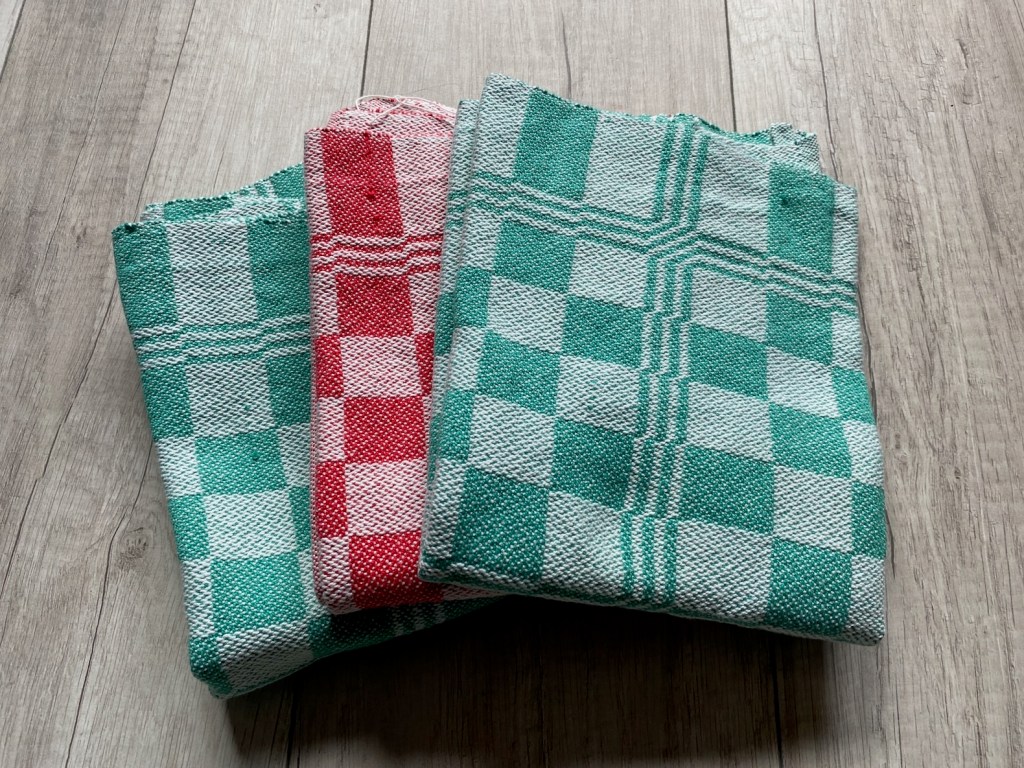
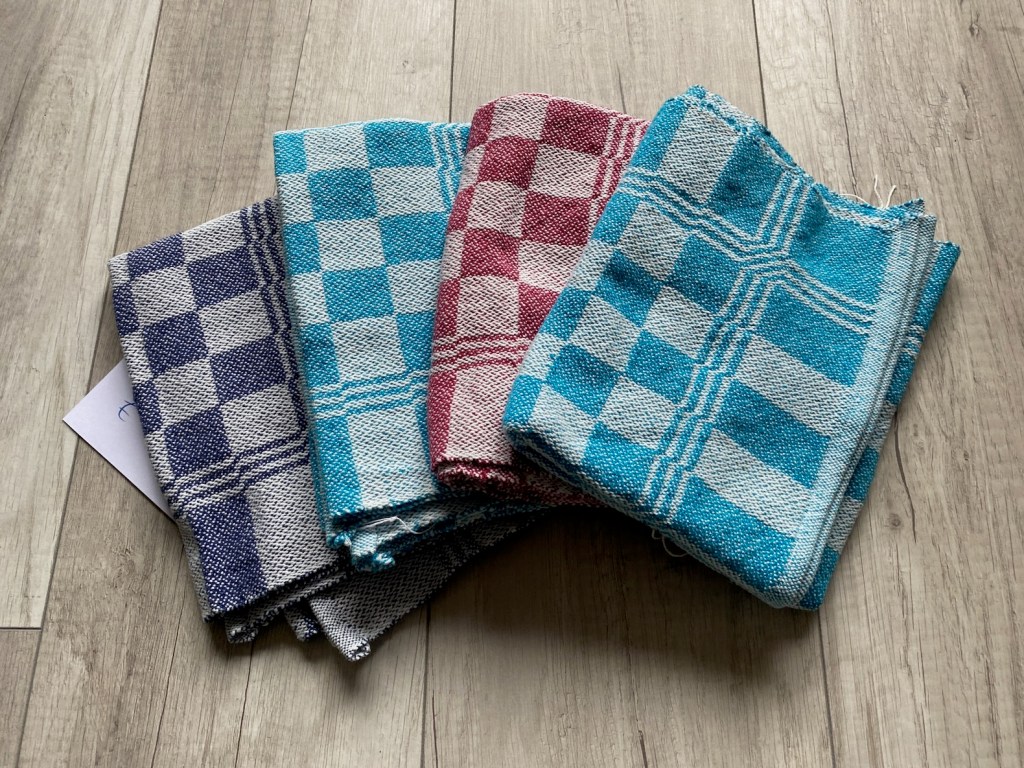
I had a variety of colours of 8/2 cotton yarn and 22/2 cotton/linen in my stack, so I chose a different colour for each dish towel. I used a small counter on the loom to keep track of the treading sequence and each towel came in at about 85 cm on the loom. Each took an average of 1 h 45 min to weave.
The biggest surprise came towards the end. I had assumed that an 8 m warp would easily give me 8 towels. I had been wondering if it might even be 9 until I realised that each towel included a 4 cm long seam on each side. But to my surprise, I reached a point about 2/3 through the eighth towel, where the warp had already been backed up right behind the shafts and I was unable to open a workable shed. Time to cut the fabric off the loom and start the finishing process.
I always secure the edges with a zig-zag stitch and wash them before sewing the final seam. The towels looked rather large straight off the loom, and I was starting to wonder if I had miscalculated.
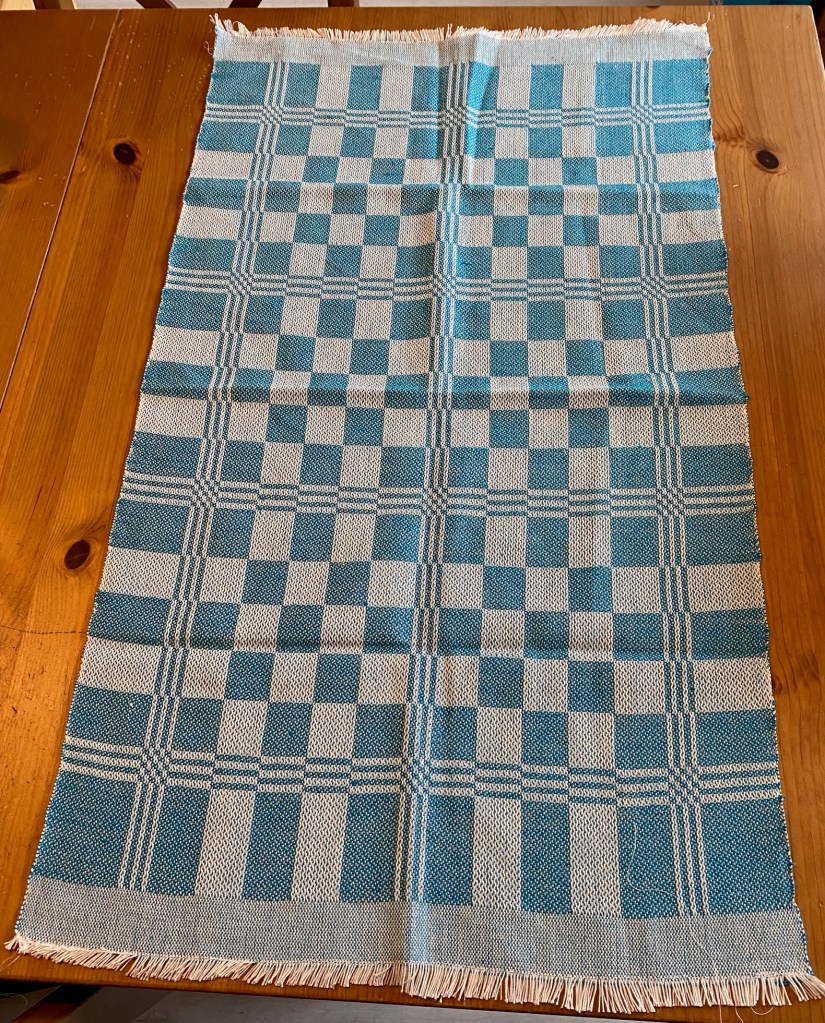
After finishing, the towels came in at about 70 x 43 cm, which is a size I like.
Due to some technical hiccups, I lost track of my working time during the finishing process, but I estimate that it took another hour for each towel. So it turned out that the actual weaving is the easy part. It actually took longer to set up the loom than to weave.
The towels turned out nicely, and I am pretty happy with the result. I calculated the price for the used material at about €15 each. But for me, the main value lies in the beauty and quality of the handmade objects.

 Snathanna